
Official home of the Lincoln County Authority of Tourism (LCAT)
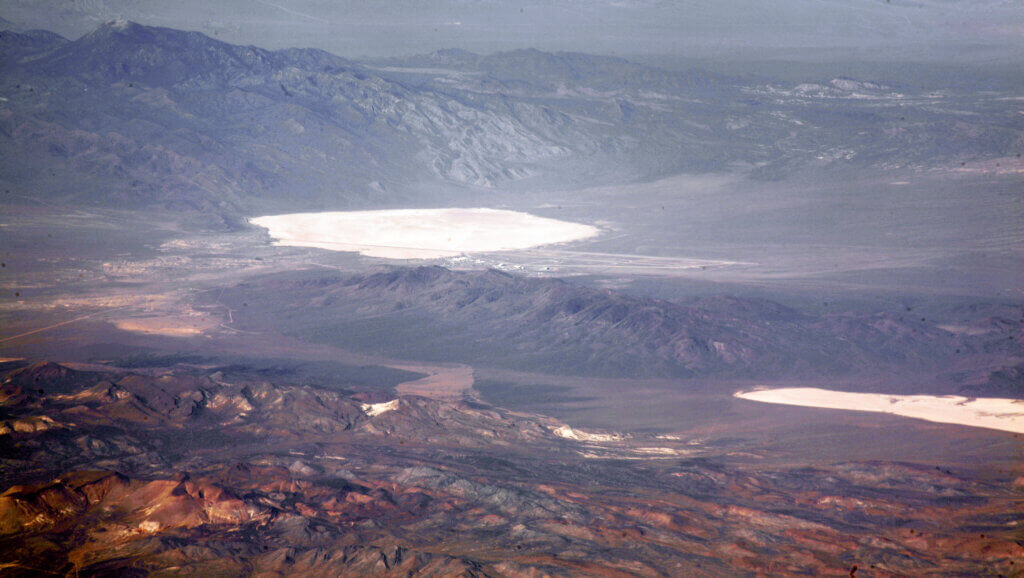
The history of Groom Lake and the surrounding high desert in Lincoln County begins with the silence of the 19th-century open range. It continues with the rumble of freight wagons and later with the thunder of atomic weapons. Today, the area is known for top-secret military operations and the sudden crack of sonic booms. For the residents of the Pahranagat Valley and the younger community of Rachel, the presence of the military at Groom Lake—known to the world as “Area 51” or the Nevada Test Site—has been a defining, and occasionally devastating, force.
Long before the military fences were installed, the Groom Lake area was a rugged, open frontier utilized by hardy ranchers and miners. In the early 20th century, the Stewart family of Alamo acquired extensive grazing rights for the Bald Mountain range, a vast territory that encompassed Groom Valley and Papoose Lake. It was a harsh environment where nature itself was the primary adversary. Dan Stewart, a patriarch of Pahranagat Valley, recalled a massive earthquake in 1914 that split the dry bed of Groom Lake open. The tremor created a fissure 15 to 18 feet wide that filled with toxic storm water, tragically killing 60 head of cattle that drank from it.
To the south of the Stewart range lay the Groom Mine, a lead and silver operation run by the Sheehan family. During World War I, the demand for lead soared, turning the remote mine into a hive of activity. William Stewart, Jr., Dan’s father, utilized his horse teams to haul heavy loads of ore from the Groom Mine across the dusty valleys to the railroad at Indian Springs. It was a time of hard labor and isolation.
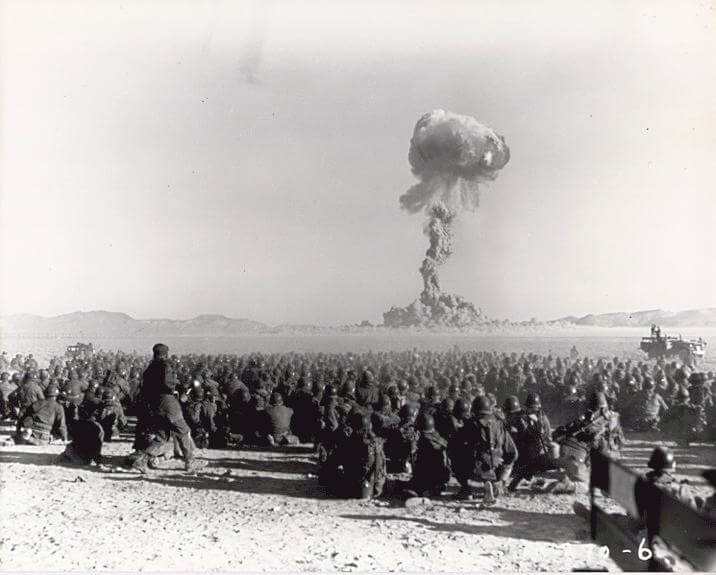
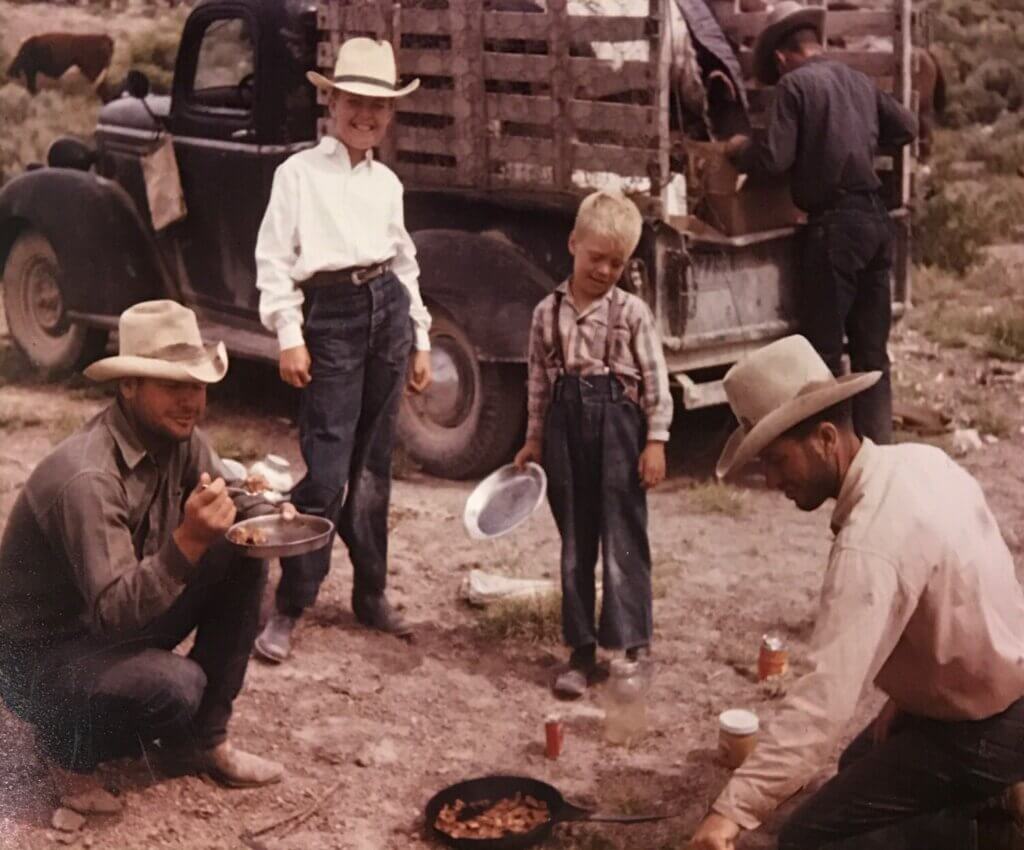
The relationship between the land and its people shifted irrevocably with the onset of World War II. The Stewart family, in a patriotic gesture, leased the west side of Bald Mountain and the Groom Lake area to the Air Force for use as a bombing range. The lease was set at a nominal fee of one dollar a year. However, as the Cold War dawned in the 1950s, the military’s use of the land changed. The Atomic Energy Commission (AEC) began testing nuclear devices nearby, turning the ranchers’ grazing grounds into the downwind fallout zone of the atomic age.
Nearby residents became unwilling witnesses to nuclear warfare. Dan Stewart described “dirty” clouds drifting over the range from the test sites to the west. While the AEC publicly insisted the fallout was harmless, the ranchers witnessed a gruesome reality on the ground. Horses grazing in the fallout zones developed large, burn-like scabs on their backs, the result of rolling in radioactive dust on the wet ground. One horse was blinded in one eye and went swaybacked due to the severity of the exposure.
Red cattle began sprouting bizarre white spots on their coats where radiation burns had healed. The contamination was so potent that when geologists or officials brought Geiger counters to the muddy bottoms of the cattle’s watering ponds, the devices would “sing” from the concentrated radiation.
The impact of the testing was not limited to livestock; it struck at the heart of the community. Oral histories contain somber, firsthand accounts of sickness among the families living closest to the testing grounds. Ferrel Stewart, a cousin of Dan Stewart who worked at the nearby Tempiute Mine, died of cancer, as did his young daughter, who was not yet twenty. Another local tragedy involved the 12-year-old son of Jack Bordoli, who died of leukemia after radiation clouds repeatedly passed over his ranch.
Dan Stewart recounted a particularly harrowing incident involving his brother’s infant son. While the family was camping near Bald Mountain, a radioactive dust cloud swept over them. The baby was burned so severely by the fallout that he had to be rushed to a hospital in Las Vegas with burns on his ear. Despite these visible tragedies, the government maintained for years that the testing was not harming the local population.
By the late 1950s, the situation had become untenable. When the Air Force attempted to renew their lease for the range, Dan Stewart refused to sign. He sent the papers back to his attorney, demanding that the government either pay for the damages or buy the ranch out entirely. The government eventually bought out the Stewart family’s grazing rights in the Groom area, ending their era of ranching on that land and closing the door to the public forever.
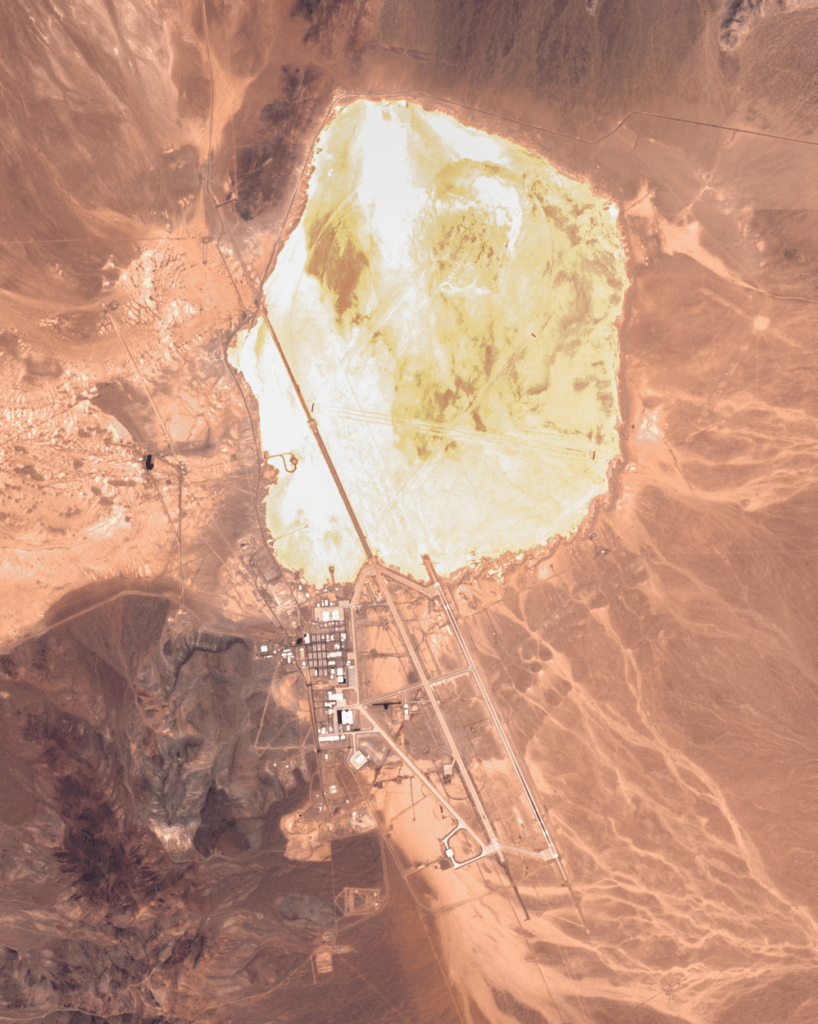
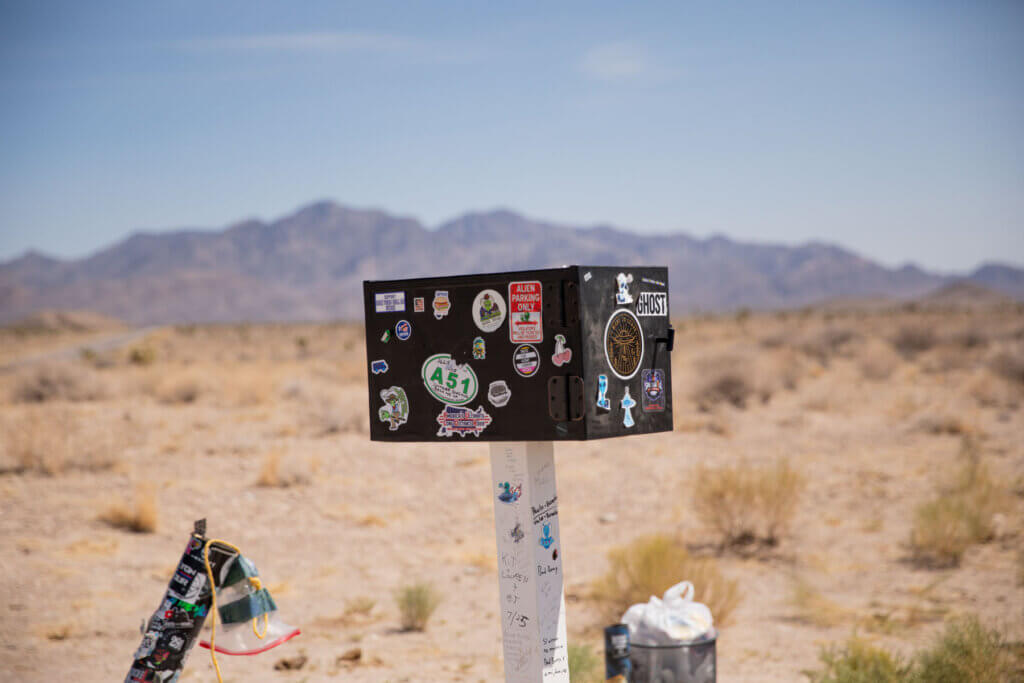
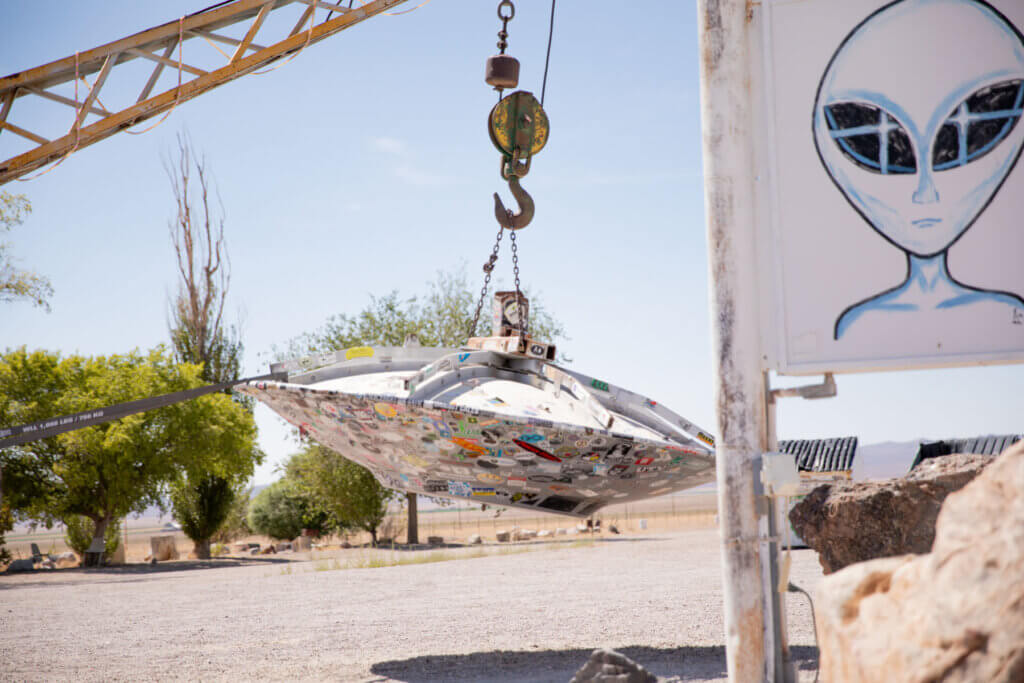
As the atmospheric atomic clouds cleared, they were replaced by the intense secrecy of “Area 51” and high-tech aviation testing at Groom Lake.
In the 1970s, the community of Rachel was born in the Sand Spring Valley, just over the hills from the secret base. Founded on the dreams of D.C. Day, who hoped to create an agricultural and residential oasis, Rachel developed a symbiotic, if strange, relationship with the military installation next door.
For the modern residents of Rachel, the Test Site became a primary economic engine. By the early 1990s, many locals worked at the site, commuting daily over Queen City Summit to the guarded gates. The site was viewed by many in the tiny town as a “good neighbor.” The Test Site provided steady employment and maintained an EPA radiation monitoring station at the local store to reassure residents of their safety—a sharp contrast to the denial experienced by the ranchers decades earlier.
The extreme secrecy of the base fueled a new industry: tourism. Stories of UFOs and aliens began to circulate, drawing busloads of tourists from California to the “Little A’Le’Inn” (formerly the Rachel Bar and Grill). While tourists scanned the skies for extraterrestrials, the locals knew the strange lights were likely advanced military technology. Edith Grover noted that the residents saw the Stealth fighter flying “long before they admitted they had it,” along with other aircraft like B-52s and F-16s.
Life in the shadow of the base had its quirks. Sonic booms became a regular part of existence, occasionally shattering windows. In these instances, the government would reimburse the residents for the damage, maintaining a pragmatic relationship with the town. Despite the noise and the tragic history of the 1950s, the community adapted. As D.C. Day noted, the residents generally believed the government was conducting experiments rather than harboring aliens, but they welcomed the tourists and the business they brought to the isolated valley.
This narrative was developed using oral histories preserved by the Lincoln County Town History Project and family history resources. Individual accounts were compiled and synthesized into a single story with the assistance of Google Gemini. It was reviewed and edited by the Lincoln County Authority of Tourism (LCAT) for accuracy and clarity. Photos were obtained through the public domain, LCAT archives, and family history resources.