Official home of the Lincoln County Authority of Tourism (LCAT)
Menu
Menu
AREA STORIES
THE ENDURING INDIGENOUS LEGACY OF LINCOLN COUNTY
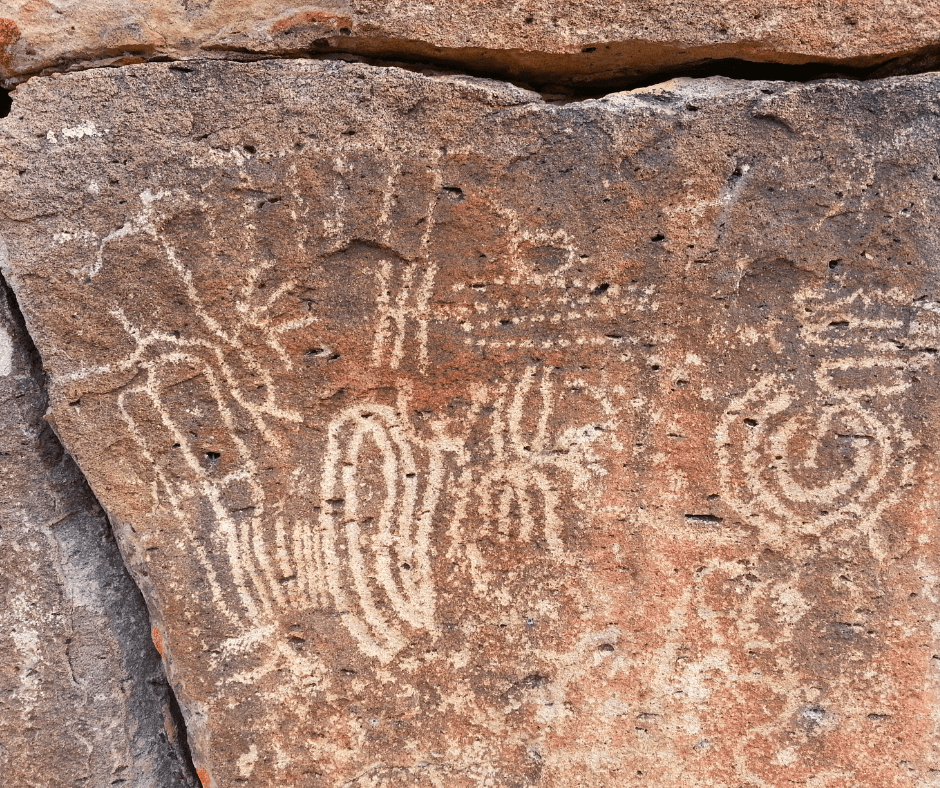
Rock art at the Mount Irish Petroglyph site. Lincoln County Authority of Tourism
The wind that sweeps down through Lincoln County carries the whispers of a history that spans over 12,000 years. Before the area was a collection of ranching towns and mining districts, it was a vast, living canvas for the Nuwu (Southern Paiute) and Newe (Western Shoshone), and the ancients who came before them. From the southern fields of Alamo to the high, snow-dusted peaks near Pioche, Eagle Valley, and Ursine, the footprints of Nevada’s first people remain deeply etched into the landscape.
The Deepest Roots
Long before the pyramids were built in Egypt, Paleo-Indian hunters stalked megafauna across the cool, wet marshes that would eventually dry into the Nevada desert. As the climate shifted around 8,000 years ago, becoming arid and unforgiving, the people adapted with a resilience that would define their culture for millennia.
This deep connection to the land left an indelible mark on the stone itself. Lincoln County holds one of the highest concentrations of rock art in North America. In the Mount Irish Archaeological District, otherworldly figures stare back at modern visitors. At the Shooting Gallery, the rock art reveals a sophisticated understanding of the hunt, where ancient engineers built blinds to funnel bighorn sheep—a sacred animal to the Nuwu—toward hunters waiting with atlatls and bows.
The memory of this ancient landscape survived through generations of storytelling. Longtime residents recalled older Native Americans sharing oral histories of a time when the desert terrain looked entirely different—recounting how ancestors would paddle canoes up and down a great, vanished river system through the White River Narrows to visit neighboring tribes in valleys that are now completely dry.
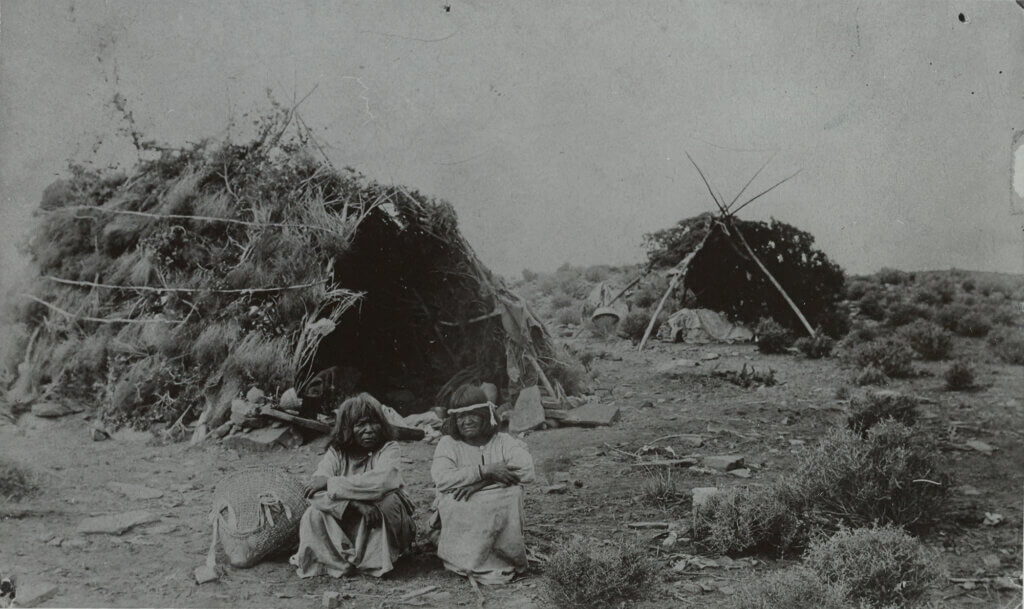
Southern Paiute wickiup, 1877. UNLV Libraries Single Item Accession Photograph Collection, approximately 1900-1999. PH-00171. Special Collections and Archives, University Libraries, University of Nevada, Las Vegas. Las Vegas, Nevada. http://n2t.net/ark:/62930/d1xp6vk3t
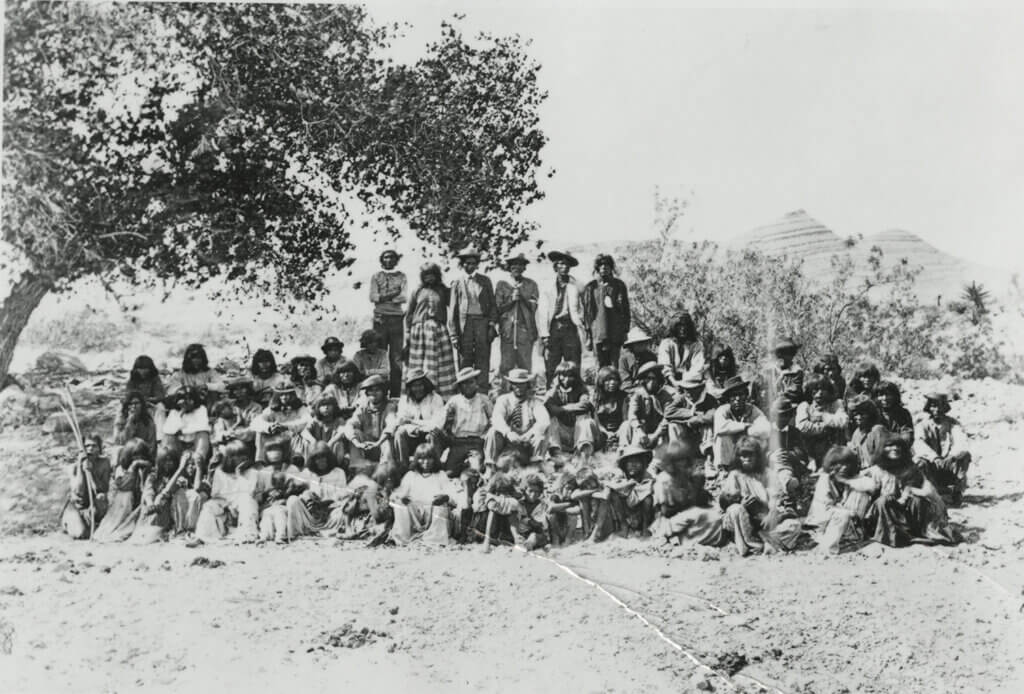
A band of Southern Paiute in an 1871 photograph taken by T.H. O'Sullivan. Inter-Tribal Council of Nevada. Courtesy of Library of Congress. Inter-Tribal Council of Nevada Photograph Collection. PH-00081. Special Collections and Archives, University Libraries, University of Nevada, Las Vegas. Las Vegas, Nevada. http://n2t.net/ark:/62930/d13x83r07.
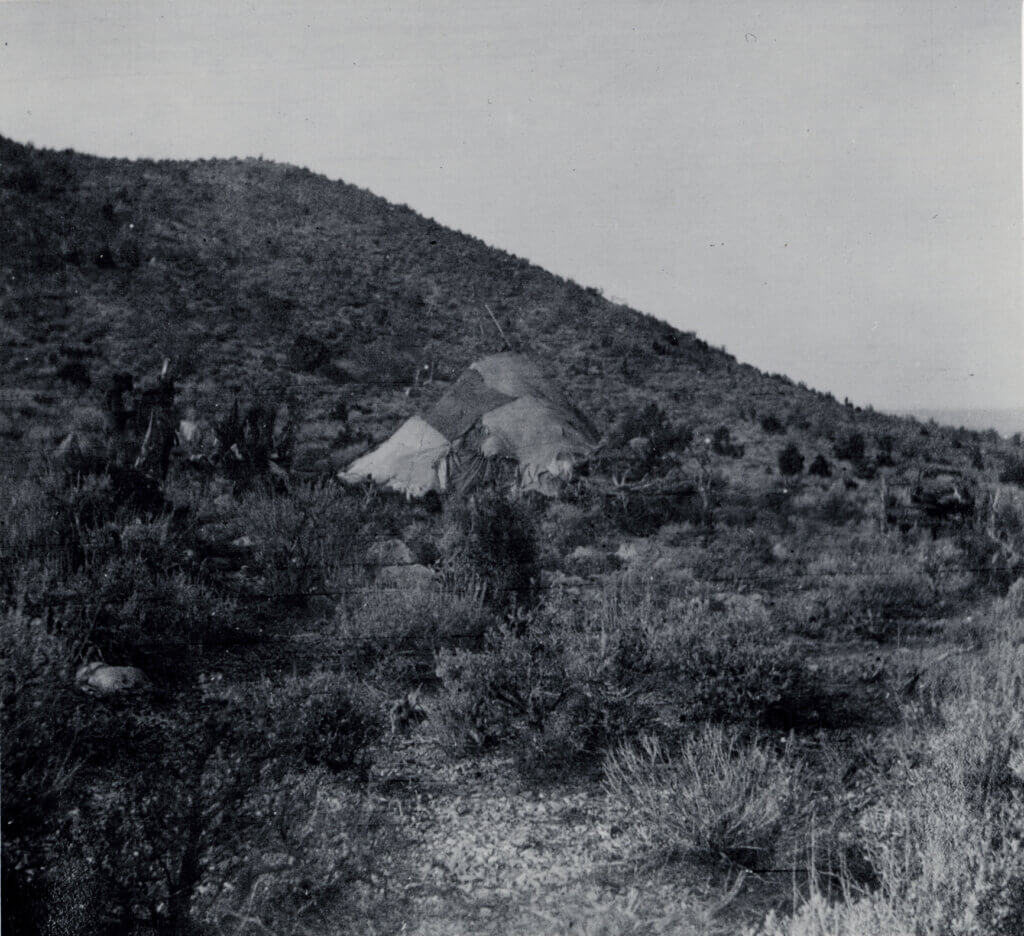
Photograph of a Paiute wickiup on a hillside, Treasure Hill, early 20th century. Lincoln County Museum Photograph Collection. Special Collections and Archives, University Libraries, University of Nevada, Las Vegas. Las Vegas, Nevada. http://n2t.net/ark:/62930/d1rr1q175
The Collision of Worlds
For thousands of years, this rhythm of life remained unbroken. But in the mid-19th century, the human landscape changed forever. White settlers began arriving, some pushing into northern areas like Pioche—where early pioneers recorded the birth of the first white child in the mining camp around 1863 —while others descended into the valleys below. The oral histories of Lincoln County’s pioneer families—the Sharps, Higbees, Lytles, and Wadsworths—reveal that this convergence of cultures was profoundly complex.
The arrival of the white settlers was not a seamless transition. When Henry Sharp and his family arrived in the Pahranagat Valley around 1865, they intended only to rest their stock before crossing the desert to California. The valley, however, was already home to a large population of Paiutes—oral accounts suggest there were up to 300 warriors, alongside their families, living in the immediate area.
Interactions quickly turned turbulent. Local tribes ran off the settlers' horses and cattle, effectively stranding the Sharp family and forcing them to stake out a permanent homestead in the valley.
Violence was cyclical and brutal. In one grim account from the late 1860s, three young travelers were ambushed at the foot of Logan Springs after being invited by a group of Indians to share a harvest of pine nuts. Two of the youths were instantly bashed in the head and killed, while the oldest boy broke into a desperate footrace, fleeing more than fifteen miles down the valley to Hiko in thin moccasins. He survived, but it took the Sharp family two weeks of painstaking care to pull the dense cactus stickers out of his raw, swollen feet and body.
Settler retaliation was severe. A posse launched a series of surprise attacks on Native encampments near Alamo and Crystal Springs, killing a substantial number of tribal members. Following the raids, the posse forced the tribes to surrender ten men, though after a chaotic release, only two were ultimately hung. This bloody conflict marked the final major outbreak of open warfare between the two groups in the valley.
Stories of Connection
Yet, in the shadow of this initial conflict, a complex web of relationships formed as the decades advanced. The lives of settlers and Native Americans became deeply intertwined, moving toward a guarded, and sometimes deeply affectionate, coexistence.
An older settler named Henry Sharp, who lived primarily among the tribes rather than in the white settlements, became a bridge between the two worlds. Because he earned their trust, the Indians shared intimate secrets of the rugged terrain with him, revealing hidden water sources and guiding him to two or three incredibly rich, hidden gold deposits in the cliffs of Sheep Mountain. Twice a year, Henry would quietly venture into the mountains, retrieve a twenty-pound sack of high-grade ore, and ship it to a smelter in Salt Lake City to pay his taxes and living expenses. Ranchers spent half a lifetime trying to track him, but he died taking the location of the “lost gold mine” to his grave. The tribes guarded these secrets fiercely. On another occasion, they blindfolded a rancher named Mrs. Geer and lowered her down a cliff on a rope just to catch a fleeting glimpse of a hidden vein.
Acts of profound humanity also cut through the cultural divide. Grandfather Joe Sharp was riding on the range near Hiko when he passed an abandoned Indian camp. Hearing a faint sound he initially mistook for a crying cat, he investigated and discovered a starving Indian boy who had been left behind. Sharp pulled the child onto his horse and brought him home, asking his father if they could keep him. Henry Sharp looked at his son and the child and declared, “Dammit, yes, you can keep him.”
The family raised the boy alongside their own children, naming him “Chiney.” He grew up fully integrated into the household, and though he eventually returned to the reservation as an adult, he maintained a lifelong bond of mutual respect with the family. On another occasion, Joe Sharp discovered three elderly, blind Native women who had been left sheltered by brush on Timpahute Mountain because they could no longer keep pace with their migrating tribe; he retrieved them and returned them safely to their camp.
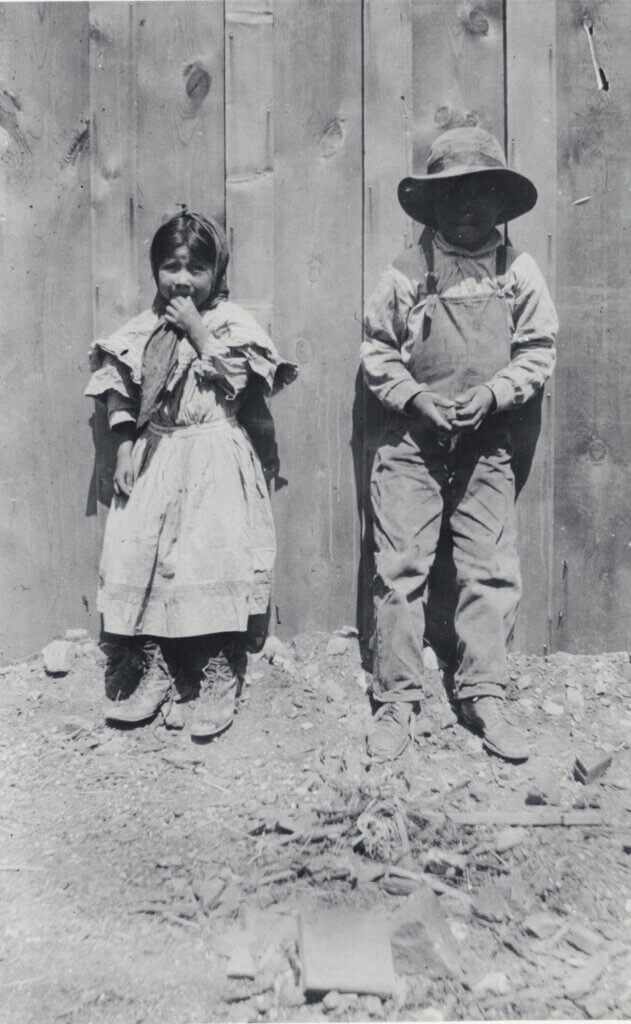
Photograph of Paiute children standing against a building, Pioche, in the early 20th century. Lincoln County Museum Photograph Collection. Special Collections and Archives, University Libraries, University of Nevada, Las Vegas. Las Vegas, Nevada. http://n2t.net/ark:/62930/d1mw28v15
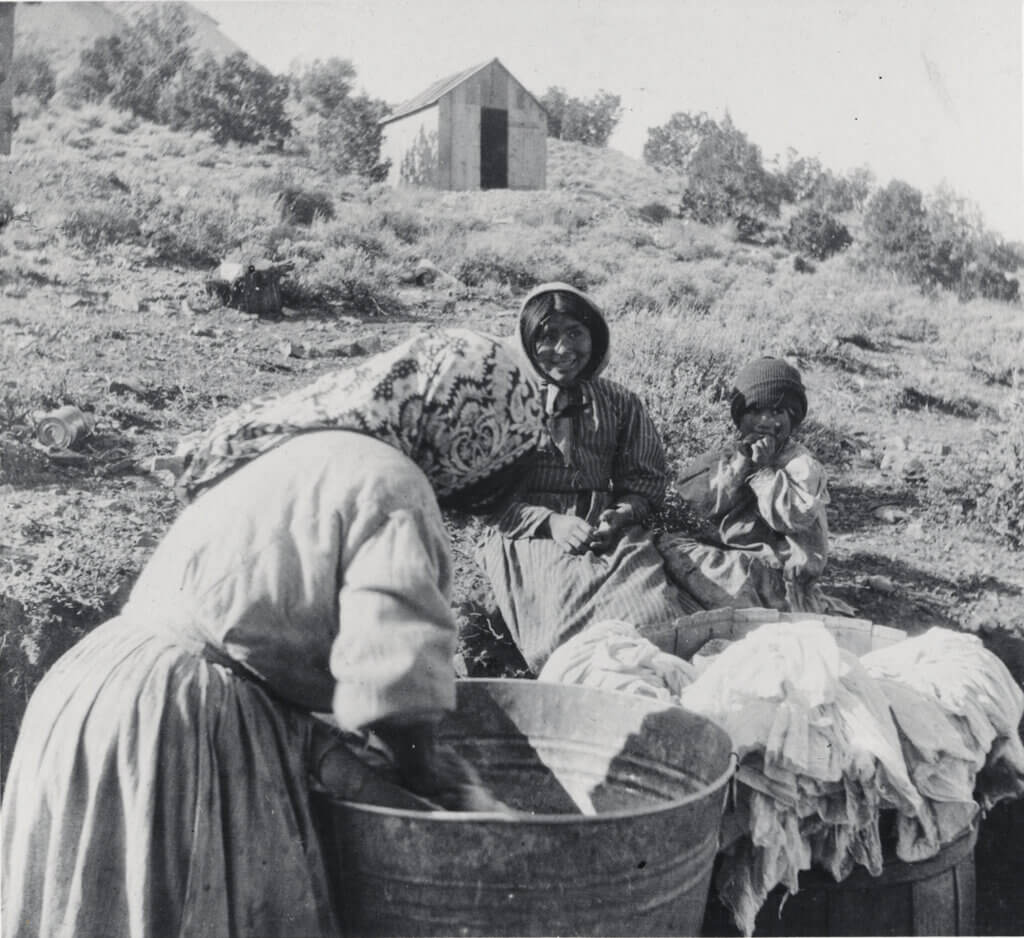
Indian washwoman and children for the Millers at the Boston Pioche mine, early 20th century. Lincoln County Museum Photograph Collection. Special Collections and Archives, University Libraries, University of Nevada, Las Vegas. Las Vegas, Nevada. http://n2t.net/ark:/62930/d1w95127m
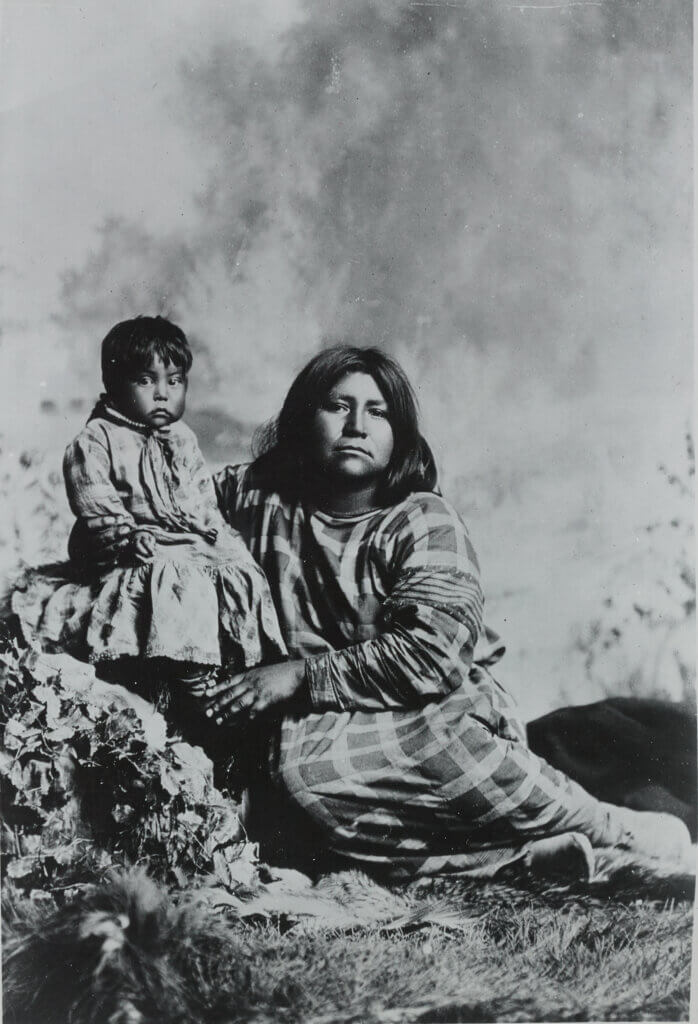
Paiute woman and child, early 20th century. UNLV Libraries Single Item Accession Photograph Collection, approximately 1900-1999. PH-00171. Special Collections and Archives, University Libraries, University of Nevada, Las Vegas. Las Vegas, Nevada. http://n2t.net/ark:/62930/d1901zx8k
Cowboys, Wranglers, and Rattlesnakes
As the 19th century turned into the 20th, the working relationship between the groups was solidified on the open range.
Native American men were frequently employed as farmhands, derrick operators, and livestock handlers. At the McGuffy ranch near Ash Springs, Native workers ran horse-powered hay derricks, occasionally shrugging off severe operational accidents with a dry sense of humor—such as one wrangler who, after being struck squarely in the face by a collapsing derrick mechanism, walked into the kitchen with a massive black eye and quietly muttered to the cooks, “My God, I saw one star.”
White cowboys held immense respect for the sheer toughness of their Shoshone and Paiute counterparts. Pioneer driver Robert Hammond, who operated out of Pioche, recalled riding northern winter roundups alongside a legendary Shoshone horse wrangler at Dutch John, located forty miles north of town on the road to Ely. The wrangler had lost his arm mid-forearm, yet he routinely outperformed able-bodied men, cutting fence posts with an axe using one hand and roping cattle expertly by cradling the coils over his amputated stub.
This northern wrangler also possessed an astonishing command of traditional medicine and wildlife behavior. During a summer drive, a valuable saddle horse was bitten by a rattlesnake, causing its chest and front leg to swell so severely that the limb dragged stiffly “like a stick.” Believing the animal was a total loss, the white cowboys prepared to move on, but the Shoshone wrangler insisted on staying behind to doctor the horse. Utilizing secret herbs gathered from the surrounding hills, he completely removed the swelling and fully restored the horse by late afternoon, tightly telling his astonished employers only that he used “Indian medicine.” Hammond also watched the same wrangler fearlessly defuse live rattlesnakes on the trail by pinning a snake’s head to the sand with a short forked stick and placing a lit, tailor-made cigarette into its mouth, rendering it completely docile.
The Quiet Years and the Great Flu
The final, catastrophic blow to this traditional way of life in the valleys arrived silently. The devastating global Spanish Flu epidemic of 1918, which crippled the ranching families, tore through the indigenous communities with catastrophic force. Oral histories note that a massive percentage of the remaining Native population died during the winter of 1918. Broken by the epidemic, the vast majority of the survivors permanently abandoned their traditional camps scattered through Frenchie Lake and the northern foothills to relocate south to the Moapa Indian Reservation. Widows like Elizabeth and notable regional families like the Pete family remained as enduring, foundational members of the Caliente and Panaca communities.
A Modern Resurgence
Today, the narrative is shifting once again. Modern tribal members describe renewed political advocacy. The Moapa Band of Paiutes were instrumental in the designation of the Basin and Range National Monument in 2015, a federal protection that shields 704,000 acres of remote desert—including the sacred rock art sites of Mount Irish and White River Narrows—from development.
For these leaders, the efforts are about protecting the “Voices of the Land.” In interviews, tribal chairmen and elders emphasize that these landscapes are not empty wilderness. They are living libraries and cathedrals. The petroglyphs at Mount Irish are not abandoned ruins; they are active spiritual sites where modern Nuwu still go to pray, leave offerings, and connect with ancestors.
This modern existence is a blend of tradition and 21st-century innovation. The Moapa Band, for instance, is building the first large-scale solar project on tribal land in the United States. Culturally, the tribes are fighting to reclaim their narrative. Events like the Snow Mountain Powwow and the Southern Paiute Veterans Powwow draw thousands of visitors, showcasing a vibrant, living culture of dance, song, and art. They are using grants to conduct ethnographic studies, ensuring that when a tourist looks at a rock art panel in Lincoln County, they hear the interpretation of the Nuwu.
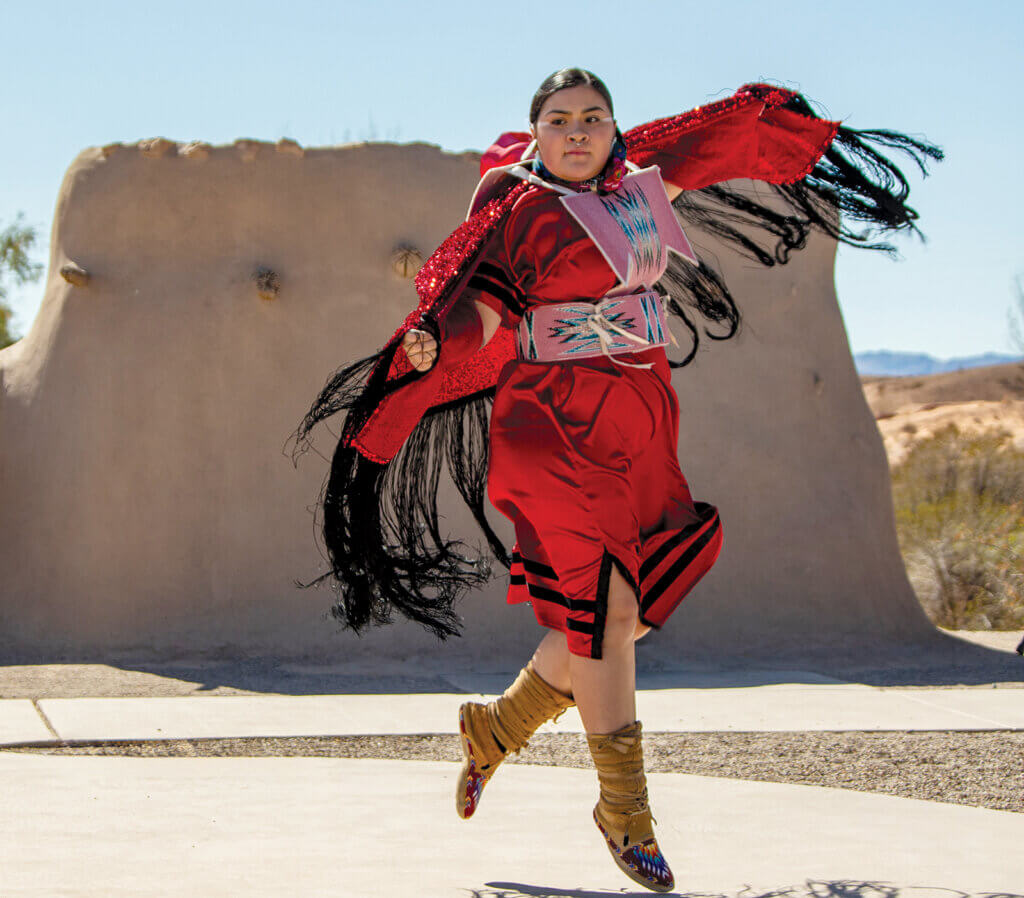
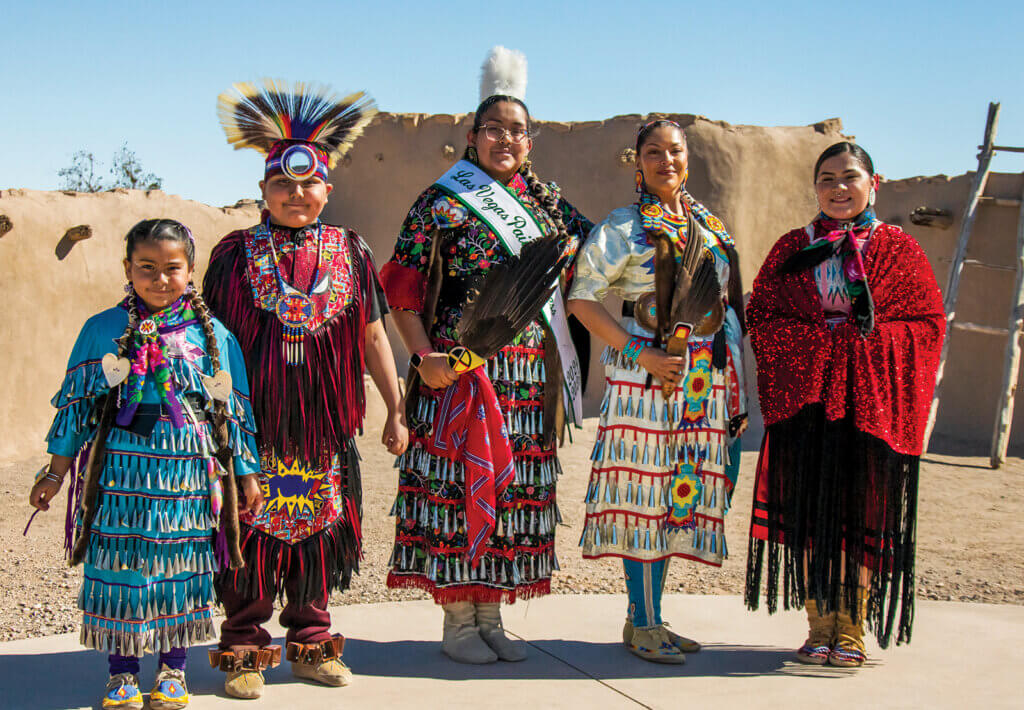
Gianna Yazzie, Las Vegas Paiute, Fancy Shawl Dancer performed at the Native American Heritage Day March 8, 2025, at the Lost City Museum. Photo courtesy of Lost City Museum & Mesa Valleys Progress
Traditional dancers at the Native American Heritage Day event pose for a picture garbed in their regalia after a successful performance. Photo courtesy of Lost City Museum and Mesa Valleys Progress.
NOTE ON SOURCES
This narrative was developed using oral histories preserved by theLincoln County Town History Project and “Preserving Our Past: Lincoln County, Nevada” by Rayette Martin (Nevada Site Stewardship Program). Individual accounts were compiled and synthesized into a single story with the assistance of Google Gemini. It was reviewed and edited by the Lincoln County Authority of Tourism (LCAT) for accuracy and clarity. Photos were obtained through UNLV Special Collections and LCAT archives.